Newbie page 3: Safety and other
(un)important matters
General
Note that there are three dangerous moments when you crash with your bike:
1. You hit your steer or the car when you are catapulted out of your seat: Check
out those leg protectors.
2. You hit the tarmac. Check out the padding on shoulders and hips (and your
helmet and hands, or course).
3. You hit another object while sliding or are run over by a passing car. This
third one is often the one that kills.
The helmet is absolutely vital for this third moment, and your speed of reaction
to avoid the crash, which means you need to survive the first two events without
passing out. It would be great to become experienced in handling a fall off
your bike, but there are no schools that will teach you this other than real-life.
People with either off-road biking experience or people trained in general falling
techniques, as taught with fight sports, will have a better chance to survive
a crash without harm.
For those days that you are depressed and want to learn more about crashing your bike: Check out the accident info on David Thompson's site. Another interesting general document is the Alabama Motorcycle Manual that is downloadable as Acrobat pdf file. See also "my first crash" further below.
Safety
I got some mails from people who told me they found riding a motorbike in
traffic a dangerous thing to do and who considered themselves cowards. I told
them they should not mistake intelligence and common sense for cowardice.
Just weeks after obtaining my license I drove over 1000 km with two friends
on sports bikes, and got used to speeds of over 100 km/h uphill and downhill
in France and Switzerland. Continuing into Italy on my own, descending a series
of hairpins on a steep mountain pass, I suddenly realized that there were no
walls or fences to protect me if I would make a steering mistake. The drop was
at least a couple of hundred meters, so I would sure end up dead in a ditch
in that case. I further noticed that the sides of the road were all gravel:
A biker's worst enemy (next to oil). When you're in a car it is not a problem
going a bit too fast into a curve. Worst case, you'd feel the car skid and loose
traction for a short moment, but there's always ample time and space to correct
that. On a motorbike, you're over the edge if you make one tiny steering or
braking mistake. No time to correct anything! To make a long story short: I
decided to slow down, spending more time on enjoying the ride and the beautiful
country side rather than trying to get downhill in the shortest possible time.
On the one hand, I felt a bit like a coward, because some of these sporty race
bikers passed me on the way down. On the other hand, I know I did the right
thing and vividly remember the great mountain views I encountered while driving
at this leisurely speed, rather than remembering only the hairpins and the color
of the tarmac. I did not get as far as I initially intended that day, but my
reduced speed and increased awareness of the environment brought me to a terrific
mountain hotel with a perfect view, friendly hosts, and an excellent dinner.
So, when I think about my trip I remember the things I've seen and the people
I met on the way. Not the fact that I perhaps could have done it a bit faster.
Practice
After passing my license test, my instructor told me it would probably take
another 15 - 20,000 km (13k miles) before I would really be comfortable on a
bike. That seemed a long time, but I now realize that it is true. It seems a
long time, but you'll think differently about it when you notice that it only
takes about 200 hours to get to this point. For comparison: You won't be able
to play the piano properly or play tennis or golf after this amount of hours.
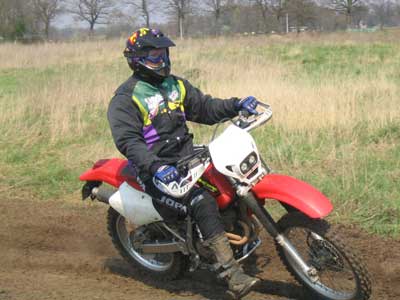
| A good thing to do after your first year or so is some additional training. For the road huggers there's circuit training, and for dirt huggers like me there's off-road training. I decided to join Henk Seppenwoolde for a day of off-road fun and training, and found it well worth the time and money. Training off-road helps you understand the movements of the bike when your front brake and/or rear brakes fail or block, or when you suddenly encounter this patch of unexpected gravel and you bike starts to head in a direction that was not your intended path. Since you're not driving your own precious bike you also feel much better about taking corners too fast, braking too fast or crashing into the mud. The experience helps you to significantly improve your riding position, allowing you to balance your bike while skidding. | |
Greetings!
One of the things you'll need to learn is how to greet other bikers. You'll
probably think "Duh!" when reading this. I agree: It is rather basic,
but it also will be totally new for newbies, so should not be forgotten here.
At this point in time you may have learnt about two types of people: Bikers,
and this sad group of Cagers. There are more. You may also meet HD's on your
way (although less often in Europe). Harley Davidson riders are seen by other
bikers as a different class, and the difference between a regular biker and
an HD is about the same as between a regular cager and a trucker. If you want
to read more about it just visit one of the many message boards of biker websites
and you will hear both the good and the bad stories about HDs.
I'd like to add two more categories to the list: Scooters and Mopeds. You may have your opinion about HD's, but they are unmistakably motor bikes. Scooters and Mopers are not. One does not greet anyone in these two categories and if you happen to misunderstand one of those fancy 50cc race mopers for real bike you'll likely feel ashamed of yourself for the rest of your journey.
Bikers great each other. They never
greet Mopers or Scooters, and will typically only greet an HD if the rider wears
normal protective gear, so no beanies or tank shirts.
You'll even need to be a bit careful with greeting other bikers. In countries
or areas where biking is considered a "sport" and reasonable protective
gear is worn, you'll greet every biker you meet. In countries where bikes are
considered an easy means of transportation (typically these are areas with a
subtropical climate) "thou shalt not greet" the bikers driving their
machine wearing shorts, slippers, and a t-shirt. These people are considered
a type of pre-roadkill and therefore not considered part of the biker community.
In areas that are crowded with bikers you will stop greeting altogether, with
one exception: You will greet all drivers that ride your brand and type of bike.
"Thou shalt greet bikers that approach you on the same road". Excluded are bikers that drive on parallel roads or that approach you on (the opposite side of) a highway. You will typically not greet the pitiful bikers that you pass on the road, unless their machine is interesting or if they are pretty. By the way: These rules more or less also apply to joggers and runners.
How does one greet? The traditional
signal is by waving horizontally or downwards with the index and middle finger
of the left hand to the left side. Don't wave your hand up: You could be mistaken
for the Pope blessing the crowd. The wave needs to be done in a cool and relaxed
way: Don't be too eager to greet, but don't be too slow either. Keep it a casual
greeting.
Most people ride road bikes and therefore lean somewhat forward on their handlebars.
Greeting another biker therefore means letting your hand being pushed a bit
sideways and downwards by the wind. This is not so easy for the more upright
all-road and off-road bikes. When you remove your hand from the handlebar driving
at highway speed on these bikes, the wind will typically blow them up, so you'll
get a Pope-wave. You'll need to do some practicing until you master the "low"
wave properly.
If you can not take your hand off the handlebar because you are either using
the clutch or need it to steer the bike, lifting the index and middle fingers
just above the handlebar will be accepted. It also is accepted if you delegate
the waving responsibility to your passenger. This actually is a good way for
your passenger to keep themself busy.
Bike theft Aaaaaaaarghhhhhhhh!
Somewhere during the very early morning hours of February 21st, my F650GS was
stolen. Sure, I had it locked with one of those "15" minute locks,
but that did not deter the thieves to simply carry the bike away, probably onto
a small truck.
It had been parked in front of my
house for months. That night, it did not have a rain cover on it because it
was frosty and dry weather. I parked it late in the evening and planned to ride
it to work early in the morning, so found no need to put the cover on it. I
guess that was the mistake I made. Unlike all these great locks, that, irrespective
of their quality, seem to last no more than 20 seconds, the rain cover does
a great job in theft protection because the potential thieves do not realize
what nice bike you have.
So I ended up without a bike and very frustrated. Thanks
to an attentive cop, my bike was retrieved one week later in another city. Although
the steering lock was broken and several parts were missing, it was in reasonable
shape. After the overhaul by the repair shop, sponsored by my insurance, the
bike actually looked better than when I bought it. I did buy two new locks and
bolted a steel bar to a concrete block in front of my house. This makes it much
less easy to steal the bike, and it will hopefully force a thief to look for
a nearby bike that is less protected.
My First Crash
Riding my motorscoot at 100 km/h (60 mph) on the highway, my front tire had
a blow out. My scooter started to make a raw noise and the steer started to
shake. It took me a second or two to realize that this wasn't an engine failure
but had something to do with one of my tires. By the time I realized this and
shut off the gas, the tire was already flat and control over the scooter was
quite impossible. It drifted left and right while slowly loosing speed. I eventually
decided to try braking slowly using the rear brake, and tried to steer the scoot
in the direction of the emergency lane. The steering movement made the scoot
loose balance, so I crashed on the tarmac and slid via the emergency lane into
sandy grassland where it stopped immediately. My crash speed probably was around
65 km/h (40 mph). I stayed conscious during the crash and was immediately back
on my feet. The scooter engine was still running. Seconds later, a friendly
couple helped me to park the scoot and took me home. There, I realized how lucky
I had been, with damage limited to some bruised ribs and skin. Although my upper
ribs were a bit sore I could still run my weekly 10-miler two days later.
The crash learning experience:
More things to come....
More on safety and anything else that comes to mind.